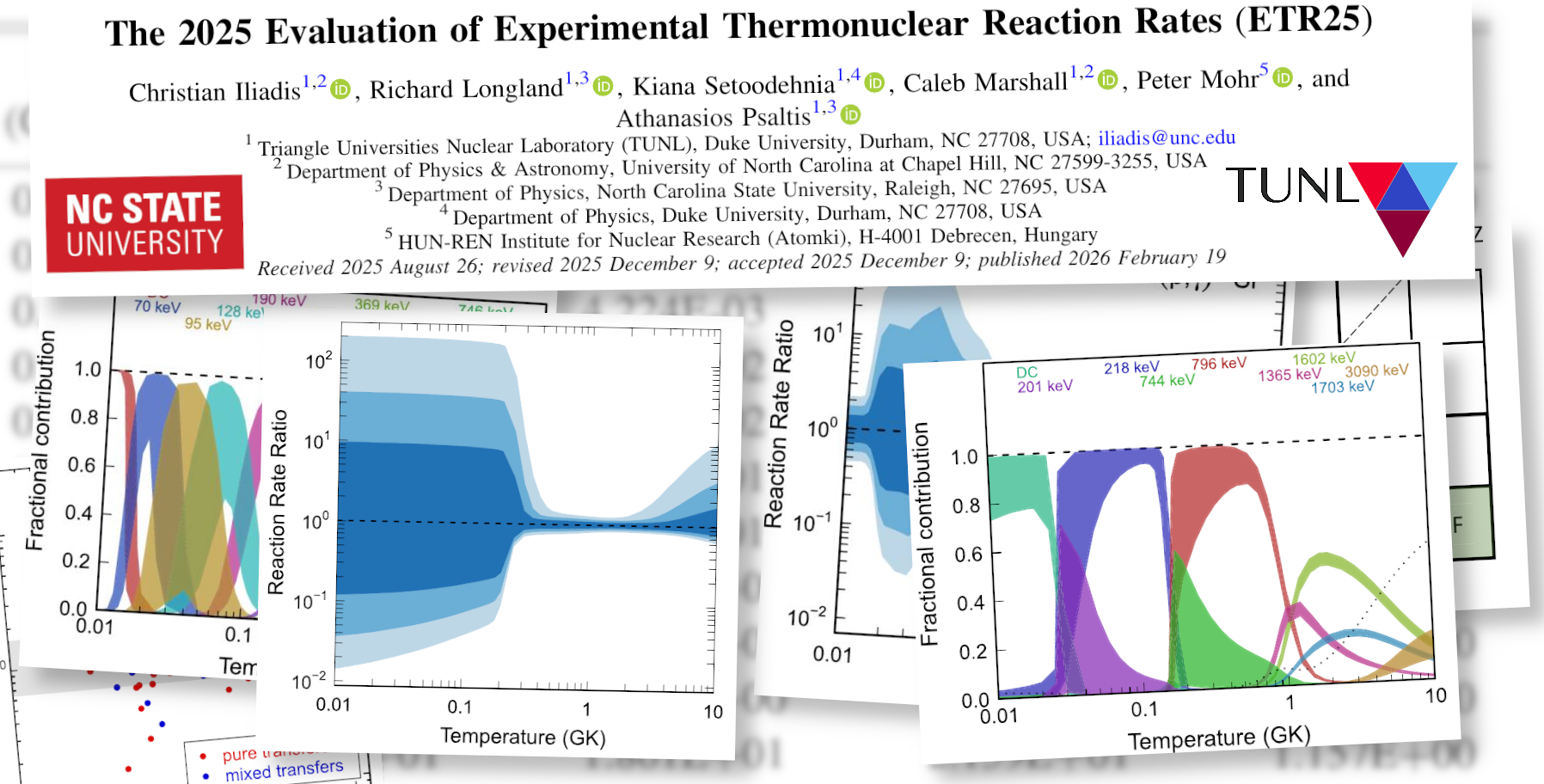
Thermonuclear reaction rates power the models that explain how stars live, explode, and create the elements. A new study co-authored by NC State faculty member Richard Longland provides a comprehensive, statistically grounded reevaluation of these rates, offering a stronger foundation for interpreting astronomical observations and simulating stellar environments. The work appears in The Astrophysical Journal Supplement (2026, Vol. 283, p. 17).
The collaboration spans the Triangle Universities Nuclear Laboratory (UNC–Chapel Hill, NC State, North Carolina Central University, and Duke University) and ATOMKI (Hungary). Authors Christian Iliadis, Richard Longland (NC State), Kiana Setoodehnia, Caleb Marshall, Peter Mohr, and Athanasios Psaltis apply modern statistical techniques—Bayesian inference and Monte Carlo methods—to incorporate prior knowledge consistently, quantify systematic uncertainties, and track correlations among nuclear parameters. The study also examines in detail how measured resonance strengths and indirectly estimated partial widths influence rate calculations across relevant stellar temperatures.
The resulting dataset provides 78 experimentally derived reaction rates tabulated over a defined temperature grid. For each reaction, the team reports statistically meaningful uncertainties and the fractional contributions of individual processes to the total rate. By anchoring rates to probability density functions and explicitly propagating correlations, the work improves transparency and reproducibility for nucleosynthesis and stellar evolution modeling.
This research strengthens the tools available to the astrophysics community and underscores NC State’s leadership in advancing precision nuclear astrophysics.